
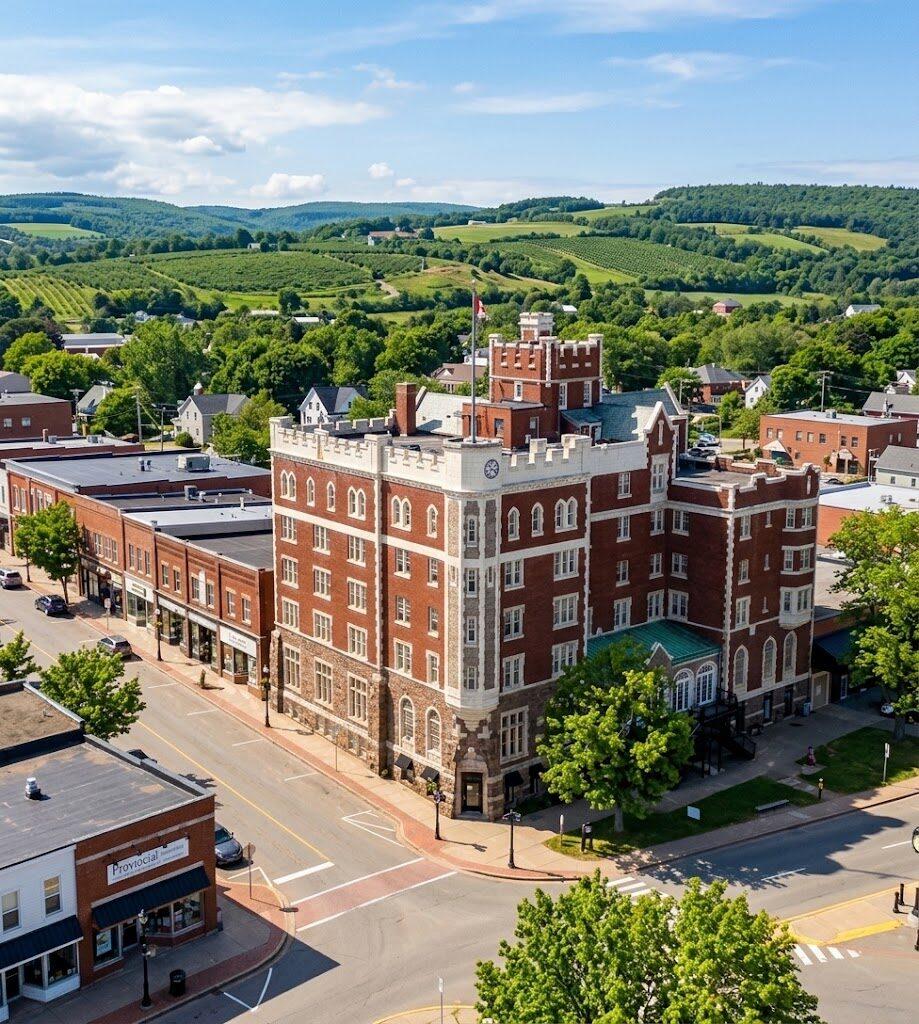
Why More Kentville Property Owners Are Choosing Solar Self-Generation
The rapid adoption of residential, commercial, and agricultural Kentville solar panels is fueled by a shifting economic landscape. Recently approved utility rate hikes have pushed Nova Scotia Power rates up by 4.1% in 2026 and 2027, with additional rider adjustments putting severe pressure on monthly household and operational budgets. Homeowners, commercial landlords, healthcare service providers, and local business owners across Kentville and Kings County are no longer looking at clean energy as just an environmental milestone; it is an urgent financial defense mechanism.
Through self-generation—the process of producing your own electricity on-site to offset what you would normally purchase at high retail prices from Nova Scotia Power—property owners can shield their assets from ongoing power rate inflation.
Kentville’s unique geographical footprint—anchored by a vibrant downtown core, medical facilities surrounding Valley Regional Hospital, commercial hubs along Park Street and Main Street, and neighboring communities like Coldbrook, New Minas, and Aldershot—features substantial year-round energy demands. By deploying on-site solar self-generation, owners can drastically reduce electricity bills with self-generation across NS, creating an immediate structural barrier against rising utility rates while significantly reducing their aggregate carbon footprint.

Is Kentville a Good Location for Solar Panels?
Kentville is an exceptional geographic location for solar energy production. Located at the heart of the Annapolis Valley along the Cornwallis River, the town benefits from strong solar irradiance and the Valley’s favorable microclimate. Nova Scotia receives over 1,800 to 1,950+ hours of bright sunshine per year, delivering a powerful solar resource for high-yield photovoltaic performance.
While seasonal variation means summer production outpaces winter output, high-efficiency monocrystalline panels generate substantial power year-round. Cold winter sunshine actually increases panel electrical conductivity, boosting efficiency on clear winter days. Optimum self-generation is achieved on roofs with an unobstructed southern or southwestern exposure pitched between 30 and 45 degrees. Modern installations easily manage Atlantic environmental factors like coastal humidity, valley fog, and winter snow through strategic panel layout engineering and microinverter integration.

How Much Does Solar Installation Cost in Kentville?
When making a long-term capital improvement, transparency around hardware and permitting costs is essential. In the current market, the gross capital requirement for a turnkey solar installation in Kentville ranges from $2.50 to $3.60 per watt, covering all premium Tier-1 equipment, engineering layout approvals, electrical grid hookups, and professional structural warranties.
Factors That Affect the Final Installation Price
Steep asphalt shingles, standing seam metal roofs, architectural gables, or historic multi-story structures require specialized attachments and safety setups.
Older properties requiring a main service panel upgrade from 100A to 200A or 200A to 400A to accommodate heat pumps and EV chargers will face minor additional pre-construction costs.
Opting for modular microinverters rather than a single string inverter increases upfront hardware costs but significantly improves long-term output resilience on roofs with complex architectural valleys or shade from mature trees.
To evaluate your layout, our engineering teams analyze your annual consumption alongside your physical roof footprint. If you want to know exactly how much solar panels cost in Kentville, the tables below map out typical system capacity requirements and panel metrics for energy independence:
Kentville Residential Solar Sizing Matrix (Based on 420W Tier-1 Modules)
| Home Profile & Size | Typical Annual Consumption | Recommended System Size – DC (Watts / kW) |
|
Small Home / Townhome (Under 1,200 sq ft) |
5,000 – 7,000 kWh |
4,500W – 6,000W (4.5 – 6.0 kW) 11 – 14 Panels Required |
|
Mid-Size Family Home (1,200 – 2,000 sq ft) |
7,000 – 10,000 kWh |
6,000W – 8,500W (6.0 – 8.5 kW) 14 – 20 Panels Required |
|
Large Executive / Farmhouse (2,000 – 3,000 sq ft) |
10,000 – 16,000 kWh |
8,500W – 13,500W (8.5 – 13.5 kW) 20 – 32 Panels Required |
Kentville Commercial & Agricultural Solar Sizing Matrix (Based on 550W Tier-1 Modules)
| Commercial Facility Profile | Typical Annual Consumption | Recommended System Size – DC (Watts / kW) |
|
Micro-Commercial (Local Retail, Professional Office) |
20,000 – 50,000 kWh |
15,000W – 40,000W (15.0 – 40.0 kW) 40 – 83 Panels Required |
|
Small-Medium Enterprise (Commercial Hub, Workshop) |
50,000 – 150,000 kWh |
40,000W – 120,000W (40.0 – 120.0 kW) 83 – 250 Panels Required |
|
Large Industrial / Ag Facility (Ag Processing, Cold Storage) |
150,000 – 500,000+ kWh |
120,000W – 400,000W+ (120.0 – 400.0+ kW) 250 – 830+ Panels Required |
Note: Individual financial metrics, precise system layouts, and exact panel counts will fluctuate naturally based on roof orientation, architectural pitch, localized shading factors, historical property consumption brackets, and the specific utility rate framework selected.
How Much Can Solar Panels Save in Kentville?
Your ongoing financial return is dictated by three primary metrics: your property’s daily consumption habits, the total physical footprint of the array, and the amount of power offset through self-generation.
For a Kentville Home
An average detached household in Kentville consuming 9,500 kWh annually (especially those using electric thermal storage or cold-climate heat pumps) can comfortably offset 70% to 90% of their consumption with a well-designed 8.5 kW solar array. In light of elevated Nova Scotia Power utility tariffs, the typical family saves an estimated $1,350 to $1,850 per year in retail electricity bill charges.
For a Kentville Business or Farm
A medium-sized enterprise, agricultural facility, or commercial property in Kentville or surrounding Kings County using heavy ventilation, cooling, or processing equipment can leverage an optimized commercial rooftop matrix to avoid high-tier commercial utility tariffs. A 100 kW system generating roughly 110,000 kWh annually saves an enterprise an estimated $14,000 to $20,000+ per year, directly shielding operational margins from future rate hikes.
Solar Payback Period in Kentville
Driven by high utility prices and strong regional solar irradiance, the typical residential solar asset features a simple payback period of 7.5 to 9.5 years. Commercial and agricultural installations utilizing accelerated tax write-offs and federal tax credits can achieve an even faster payback of 4 to 6 years, converting the system into a pure profit-generating asset for the remainder of its 25+ year operational life.
Solar Incentives Available in Kentville
Maximizing your return on investment relies on stacking active federal corporate tax credits, utility net metering, provincial rebate pathways, and private incentive frameworks.
NS Residential Solar and Battery Incentive Frameworks
Homeowners in Kentville can strategically utilize distinct financial pathways to capture premium benefits:
|
Solar Program & Pathway |
Financial Incentives & Benefits |
Grid Operational Model |
Target Profile |
|
Polaron Greener Home Loan |
Competitive 0% financing |
Polaron Exclusive 0% Financing: Flexible monthly payment plans engineered so energy bill savings offset technology payments. |
Homeowners seeking flexible in-house financing and complete power backup without bank loan friction. |
|
[PROGRAM CLOSED] |
Previously offered up to $0.30/watt (max $3,000) for residential solar PV |
No Longer Accepting Applications: Efficiency Nova Scotia officially stopped accepting new residential applications on April 17, 2025. |
Grid-connected residential Nova Scotia Power customers installing eligible solar PV systems. |
|
Canada Greener Homes Loan [PROGRAM CLOSED] |
Previously offered up to $40,000 at 0% interest for 10 years |
No Longer Accepting Applications: Federal funding intake for this loan program is officially closed to new applicants. |
Homeowners who secured pre-approval prior to the intake closure. |
Commercial Solar and Battery Incentives
Enterprise, agricultural, and non-profit operations can leverage powerful commercial incentives across Nova Scotia to offset upfront deployment friction:
| Incentive Program & Framework | Financial Capital Support Details | Strategic Operational Advantage |
| Polaron Exclusive Commercial Incentive |
|
Turnkey Capital Relief: Direct capital offset applied directly to lower system equipment and deployment costs, accelerating your ROI and reducing upfront friction without relying solely on tax credits. |
| SolarHomes Program for Non-Profit Organizations |
|
Direct Grant Offset: Non-repayable rebate administered by Efficiency Nova Scotia, helping registered non-profits and charities reduce initial system deployment costs. |
|
Federal Clean Technology Investment Tax Credit (ITC) |
|
Direct Corporate Tax Shield: Applied directly against the total capital expenditures of eligible hardware, battery storage, and installation costs. |
| Accelerated Capital Cost Allowance (Class 43.1 / 43.2) |
First-year write-off for clean energy equipment |
Immediate Liquidity Boost: Allows incorporated businesses and farm operations to write off the full capital asset cost in year one. |
How Net Metering & Behind-The-Meter Work in Kentville
Understanding how your solar infrastructure connects to the grid and manages daily generation is key to choosing the right system architecture for your Kentville property.
Net Metering
If you choose to maintain a traditional grid-tied connection, you can enroll in the Nova Scotia Power Net Metering Program. This framework is available to both residential households and commercial/agricultural operations within Kentville, allowing property owners to leverage the public grid to optimize generation economics.
Solar Credits
When you enter a net metering agreement, Nova Scotia Power installs a specialized bidirectional smart meter. When your solar system produces more electricity than your property consumes during peak daylight hours, the surplus flows back to the public grid. The utility tracks this volume and applies a non-cash credit directly to the electricity consumption line item on your monthly hydro statement, officially recorded as your “Generation Credit Balance”(Energy Credit). For both residential and commercial accounts, this credit directly offsets volumetric energy charges.
What Happens to Unused Solar Credits
During high-production summer months, your system will accumulate a substantial reserve of generation credits. Under Nova Scotia Power net metering rules, these credits roll forward to offset subsequent monthly statements, allowing you to use your summer abundance to pay for winter heating or operational demand. At the end of the annual 12-month billing cycle, any remaining net excess generation is paid out by Nova Scotia Power, ensuring every kilowatt-hour generated holds tangible financial value.
Behind-The-Meter (Load Displacement)
Choosing whether to integrate physical energy storage (Behind-the-meter / Load Displacement) depends entirely on your property’s specific backup requirements, operational risk profile, and target utility billing structure.
Without Battery Storage
A standard grid-tied solar system without physical energy storage operates on a direct self-consumption model. When sunlight strikes your panels, the electricity generated flows directly into your property’s main electrical panel first, immediately powering running appliances, heat pumps, lighting, and operational equipment on-site. If your system produces more electricity than your property currently needs, that excess energy flows outward through your bidirectional smart meter onto the public utility grid, earning non-cash solar credits under a traditional net metering framework. Conversely, when your energy needs exceed your panel output—such as at night or during heavy overcast weather—your property seamlessly draws supplemental electricity back from the grid.
The primary trade-off of this setup is complete grid dependence. Because there is no battery on-site to store power or form an independent microgrid, a standard grid-tied system must automatically de-energize during local utility outages to comply with anti-islanding safety regulations and protect utility line workers—leaving your home or business without power during blackouts.
With Battery Backup
Pairing your solar system with an advanced lithium-iron-phosphate (LFP) battery storage system unlocks complete operational autonomy. If the local grid fails during severe Atlantic storms, the system instantly isolates your property into an independent microgrid within milliseconds, keeping critical infrastructure running seamlessly.
- For Homeowners: It ensures lighting, medical equipment, refrigeration, well/sump pumps, and heating systems remain operational through extended winter outages.
- For Commercial Facilities & Farms: It protects delicate inventory, keeps cold storage and ventilation online, prevents costly operational restarts, and secures business continuity.
Net Metering VS Behind-The-Meter (with Battery Storage)
Net metering utilizes the public utility grid as a virtual battery, allowing you to store financial value in the form of an Energy Credit / Solar Credit. Physical battery storage, conversely, keeps your energy completely behind the meter for direct load displacement. The core trade-offs between these two frameworks include:
Net Metering:
Excellent for long-term seasonal generation balancing (using summer abundance to offset winter demand), but it does not provide backup power during grid blackouts due to anti-islanding safety regulations.
Behind-The-Meter:
Provides total operational resilience and instantaneous backup power. For commercial facilities, behind-the-meter battery matrices unlock advanced peak-shaving capabilities to actively lower demand surcharges.
How Much Battery Capacity Does a Kentville Property Need?
| Property Profile | Storage Capacity Range | Coverage |
| Residential Essential Backup | 10 kWh – 13.5 kWh | Powers baseline emergency loads: refrigeration, Wi-Fi routers, device charging, and select lighting networks. |
| Residential Whole-Home Backup | 20 kWh – 30 kWh | Supports heavy-draw residential appliances: central air conditioners, well pumps, electric dryers, and EV chargers. |
| Commercial / Agricultural Backup | 30 kWh – 100 kWh+ | Engineered to sustain critical business infrastructure: cold storage, wine cellars, security networks, emergency lighting, and essential machinery. |
Is Your Kentville Property Suitable for Solar?

Roof Direction and Pitch
The ideal architectural setup features an unobstructed southern, southeastern, or southwestern roof face. A roof pitch between 28 and 40 degrees allows for optimal year-round sunlight collection and natural rain/snow shedding.

Roof Age and Structural Condition
Solar panels feature an operational lifespan exceeding 25 to 30 years. Polaron strongly recommends that your roof shingle or metal base has at least 15+ years of structural life remaining before deployment.

Trees, Buildings, and Shading
Persistent shade from neighboring trees or farm structures reduces panel yield. Our team utilizes advanced 3D solar irradiance software to map shade footprints, integrating high-performance microinverters to isolate shaded panels.

Ground-Mounted Solar Options
If your roof faces heavy shading or poor historical orientation, ground-mounted solar systems are an excellent alternative for spacious farm parcels, research facilities, and acreage properties across Kings County.
The Solar and Battery Installation Process in Kentville
Polaron manages every single phase of your renewable transition through a proven, comprehensive service model.
Electricity Usage and Property Assessment
We evaluate your historical Maritime Electric statements to pinpoint your specific consumption peaks and assess your structural roof layout.
Solar System Design and Proposal
Our engineering division develops a custom 3D model of your property, optimizing panel placement to maximize solar production.
Permits and Utility Applications
We manage the entire administrative process on your behalf, submitting complete engineering packages to secure local municipal building permits from the Town of Kentville (or Municipality of the County of Kings for surrounding areas) and coordinating directly with Nova Scotia Power for net metering interconnection pre-approval.
Equipment Installation
Our certified installation crews deploy your complete system—securing structural flashing, heavy-duty aluminum racking, Tier-1 panels, and smart battery modules in 1 to 2 business days.
Inspection and Grid Connection
Following installation, we coordinate mandatory electrical inspections through Nova Scotia Power / Provincial Electrical Inspectors. Once approved, NS Power authorizes your system to connect to the grid.
Monitoring and System Activation
We energize your asset and configure your cloud-based performance monitoring software, giving you real-time visibility into your daily self-generation.
Solar Permits and Approvals in Kentville
Operating grid-tied energy infrastructure requires strict adherence to regional safety rules. A standard deployment requires an active Building Permit from the Town of Kentville (or Municipality of Kings) to certify structural roof loading safety under local wind and snow conditions.
Furthermore, all electrical configurations must strictly comply with the Canadian Electrical Code (CEC), verified by an official provincial electrical inspector. Finally, a formal net metering agreement must be finalized through Nova Scotia Power before your system can legally export power. Polaron manages this complete permitting process internally to ensure a smooth transition.

Do Solar Panels Work During Kentville Winters?
Yes, solar panels perform exceptionally well during Annapolis Valley winters. While winter daylight hours are shorter, photovoltaic technology relies on light, not heat, and solar panels actually operate with heightened electrical efficiency in cold temperatures. Furthermore, light reflection off surrounding snow (the albedo effect) boosts generation on clear winter days. Because dark panels are tilted and generate heat while producing power, light snow accumulation sheds quickly. Your self-generation system is engineered to capture the vast majority of its annual production targets during the long, sunny months between spring and autumn, banking enough net metering credits to comfortably absorb the winter dip.
Solar Panels for Kentville Businesses, Farms and Commercial Buildings
Commercial enterprises, corporate offices, healthcare facilities, and agricultural operators across Kentville can turn their expansive roof or land profiles into active financial shields against rising power costs.

Commercial Rooftop Solar
Commercial plazas along Park Street, medical buildings, manufacturing facilities, and offices in Kentville can utilize expansive roof space to deploy high-output solar arrays. This infrastructure converts a fixed monthly operating expense into an independent capital asset, dramatically increasing commercial building equity.

Solar for Farms, Research Facilities, and Agriculture
Agricultural operations across Kings County face distinct energy demands, from operating cold storage units and packing plants to powering ventilation lines. Farm operators are uniquely positioned to maximize clean energy investments due to abundant roof and land availability. You can easily stack federal corporate tax incentives with self-generation savings to lock in a highly resilient source of low-cost energy.
How to Choose a Solar Installer in Kentville
Selecting the right partner to design, permit, and construct your multi-decade clean energy asset is the most important decision you will make. Use this essential buyer checklist when evaluating providers.
Choose a full-service partner like Polaron that manages your complex Nova Scotia Power net metering paperwork and municipal permits in East/West Hants. Also, Polaron offers an exclusive rebate up to $25,000 for commercial projects, and flexible in-house financing for both homeowners and business owners to reduce upfront capital barriers.
Ensure your provider has a verified track record of successful installations within Nova Scotia’s specific grid jurisdictions and thoroughly understands local building and electrical codes.
When searching for the best solar company in Kentville, verifying their technical qualifications is essential. Your chosen provider must employ certified electricians and carry comprehensive commercial general liability insurance along with active Workers’ Compensation coverage.
Premium installations should only feature Tier-1 hardware backed by a 25-year linear performance warranty.
(Note: Polaron goes above the industry standard by offering an exclusive 30-year warranty for solar panels)
Ensure your installer provides continuous, cloud-based system monitoring software and has a dedicated customer support team ready to assist you for decades to come.
Why Choose Polaron as Your Solar Installer in Kentville?
As Canada’s premier clean energy authority with over 14,000 successful installations nationwide, Polaron Solar delivers a seamless, 100% turnkey clean energy transition tailored specifically to Nova Scotia. In the face of steep Nova Scotia Power electricity rate hikes and the recent closure of provincial rebate programs, Polaron is stepping up to bridge the gap. We provide exclusive, direct-to-consumer financial relief, including 0% financing (Polaron Greener Home Loan) for residential projects and a massive $25,000 incentive for commercial installations, alongside our exclusive in-house financing.
Our certified in-house teams guarantee strict safety compliance with the Canadian Electrical Code throughout the entire project lifecycle. By expertly managing every single detail—from custom 3D engineering layouts and municipal building permits in Kentville to Nova Scotia Power Net Metering grid connections—Polaron pairs top-tier technology with flexible internal financing to permanently shield your property from utility rate increases.
Being in the renewable energy industry for 13 years, with expert solar design, installation, and incentive support.
Ready to See If Solar Makes Sense for Your Property?
Get a customized solar assessment based on your property and electricity requirements.
Frequently Asked Questions
01 / Is solar self-generation worth it in Kentville, NS?
Yes. Backed by over 1,800+ annual sun hours, rising Nova Scotia Power electricity rates, active incentives, and net metering, installing solar allows you to generate your own clean power, shield your property from utility inflation, and lock in low-cost energy for decades.
02 / How much does it cost to install solar panels in Kentville?
Turnkey commercial and residential installations typically range between $2.50 and $3.60 per watt. A standard 8.5 kW residential rooftop array requires an estimated gross investment of $22,000 to $29,000 before applying eligible 0% financing via Polaron Greener Home Loan or commercial tax credits.
03 / How do Nova Scotia Power rate hikes affect solar savings in Kentville?
As Nova Scotia Power increases its retail electricity rates, every kilowatt-hour of energy your solar system generates becomes significantly more valuable. Higher utility rates shorten your simple payback period and increase your total multi-decade financial savings.
04 / How many solar panels do I need for my Kentville home or farm?
The typical detached residential home requires an array size between 7 kW and 12 kW to balance its utility footprint (especially with heat pump usage), which translates to roughly 14 to 29 premium solar panels depending on your total historical consumption. Farms and commercial operations may require larger rooftop or ground-mounted arrays (30 kW to 100 kW+).
05 / Can self-generation eliminate my electricity bill?
Under Nova Scotia Power’s net metering program, your solar system can comfortably generate enough credit to wipe out your volumetric energy usage charges over a 12-month cycle. However, you will still receive a minimal monthly bill to cover standard fixed basic customer service charges.
06 / Do solar panels work during Nova Scotia winters?
Yes. While winter days are shorter, solar panels rely on light, not heat, and operate with heightened efficiency in cold weather. Tilted panels shed light snow quickly, and systems are engineered to over-produce in the summer to comfortably absorb seasonal winter drops.
07 / Can I add a battery after installing solar?
Yes. While integrating a battery storage system during your initial solar installation maximizes your financial return and simplifies the electrical permitting process, you can easily retrofit a smart battery backup to an existing solar system down the road.
08 / Does solar increase property value in Kentville?
Yes. Multiple real estate economic studies confirm that buildings equipped with independent, revenue-generating clean energy infrastructure command a premium market value and sell significantly faster than properties fully reliant on the public grid.
09 / How long do solar panels last?
Premium Tier-1 monocrystalline panels are engineered for exceptional durability against wind and weather, featuring an operational lifespan of 30+ years. Most systems continue to produce reliable, clean electricity well beyond their initial 30-year warranty period.
10 / How long does the installation process take?
The actual physical construction requires only 1 to 2 business days. However, the full end-to-end lifecycle, including engineering design adjustments, municipal building permit reviews in Kentville, and final Nova Scotia Power grid connection, takes approximately 3 to 5 months.


.70e3bcd1.svg)
.6c51ffe3.svg)
.8cbc05bd.svg)
.d07f37ca.svg)
.a26b3396.svg)
.29c01fed.svg)